




I grew up in an achievement-oriented household, where each member of my family was held to a high standard. From a young age, I could feel the weight of this “invisible bar,” along with the condemnation that inevitably followed whenever I fell short of perfection.
Over time, this conditioned perfection crippled me from the inside. I expected it from both myself and others, which inevitably led to an intense fear of judgement and simultaneous shame for judging others. A harmful (unbiblical) belief system, which I’ve been steadily bringing to God, asking Him to heal.
Recently, God has showed me that the root of perfectionism is shame. Somewhere along the way, I learned that if I missed the mark, I wasn’t lovable or “enough” in my relationships. Shame took root and a stream of self-condemning thoughts followed. Sound familiar?
But the truth is: I will never be able to reach that invisible bar. No one can. And thankfully, that bar does not measure my worth. God’s grace does!
Jesus Christ’s sacrifice on the cross is evidence of this: “But God shows his love for us in that while we were still sinners, Christ died for us.” (Romans 5:8)
God does not extend His grace to us because of what we do, but because of what Christ has done. And as His children, we are offered a profound gift: the gift of grace. Can we open our hands to receive it? And lavish it upon others?
Today, I want to explore the story of shame, why Jesus Christ came to set us free from it, and how we can open our hearts fully to accept and give God’s grace.

“For it is by grace you have been saved, through faith—and this is not from yourselves, it is the gift of God—not by works, so that no one can boast.” (Ephesians 2:8-9)
The Story of Shame
Shame isn’t new. In fact, it’s as old as Adam and Eve in the Garden of Eden. To understand shame, we have to revisit the moment we first sinned.
Before the Fall, Adam and Eve were in perfect relationship with God. They were innocent, morally pure, and had the freedom to obey or disobey Him (Genesis 1:31). Sin had no hold over them, so shame wasn’t known.
Life in the Garden was good, but God still set boundaries. He gave Adam and Eve freedom, but warned them not to eat of the Tree of Knowledge and Evil.
And the Lord God commanded the man, saying, “Of every tree of the garden you may freely eat; but of the tree of the knowledge of good and evil you shall not eat, for in the day that you eat of it you shall surely die.” (Genesis 2:16-17)
But the Serpent (many believe to be Satan) was crafty, convincing Adam and Eve to disobey God. When they ate of the Tree of Knowledge, their eyes were opened to both good and evil. Aware of their nakedness, they covered themselves up, hid from God, and felt fear for they were now fully conscious of their sin.
“So when the woman saw that the tree was good for food, that it was pleasant to the eyes, and a tree desirable to make one wise, she took of its fruit and ate. She also gave to her husband with her, and he ate. Then the eyes of both were opened, and they knew that they were naked; and they sewed fig leaves together and made themselves coverings.” (Genesis 3:6-7)
That day, shame entered the Garden, bringing forth fears of disconnection, rejection, and unworthiness. This was the moment our spiritual unity with God was broken. Humanity has felt the burden of our condition ever since.
Thankfully, the story doesn’t end there. God doesn’t leave us condemned. Through belief in Jesus Christ’s death and ressurection, God gives us the ability to be reconciled to Him.
Which leads me to the question: do we truly believe God’s grace is sufficient?

God’s instructions are always for our ultimate good.
The Gift of Grace Through Jesus Christ
The answer to the previous question is biblically steadfast: God’s grace is sufficient.
Jesus Christ paid the price of all of our sins on the cross. All of them. Every careless word, senseless action, and unholy thought. Paid for in full.
God does not hold us to the past, but sets our eyes on our future in Christ. Therefore, as followers of Christ, we are set free from the shackles of sin, guilt, and shame. In fact, Paul reminds us in 2 Corinthians 12:9: “But he said to me, ‘My grace is sufficient for you, for my power is made perfect in weakness.’”
Though we take God’s hand and strive to be like him, we are not expected to reach His perfect standard. And we are not inevitably rejected by Him when we fall short. Grace beckons to us in imperfection, as evidenced in the Bible. Take a look at the story of Joseph forgiving his brothers, the prodigal son welcomed home, or the thief on the cross promised paradise. I see God’s heart of grace echoed in each of these stories. Truly, our God is a God of grace:
- Romans 5:20: “Where sin increased, grace abounded all the more.”
- Ephesians 2:8: “For by grace you have been saved through faith.”
- Hebrews 4:16: “Let us then approach God’s throne of grace with confidence.”
- John 1:16: “From his fullness we have all received, grace upon grace.”
Grace is unearned, unlimited, and unconditional in Christ. Read that again! And rejoice! We don’t have to earn God’s grace, but only have to open our hearts to receive it. If we are walking steadily in Christ, we are afforded His grace to fall short, pick ourselves back up, and keep walking with God.

“For the law was given through Moses; grace and truth came through Jesus Christ.” (John 1:17)
How to Fully Accept God’s Grace
“For the Scripture says, ‘Whoever believes on Him will not be put to shame.’” (Romans 10:11)
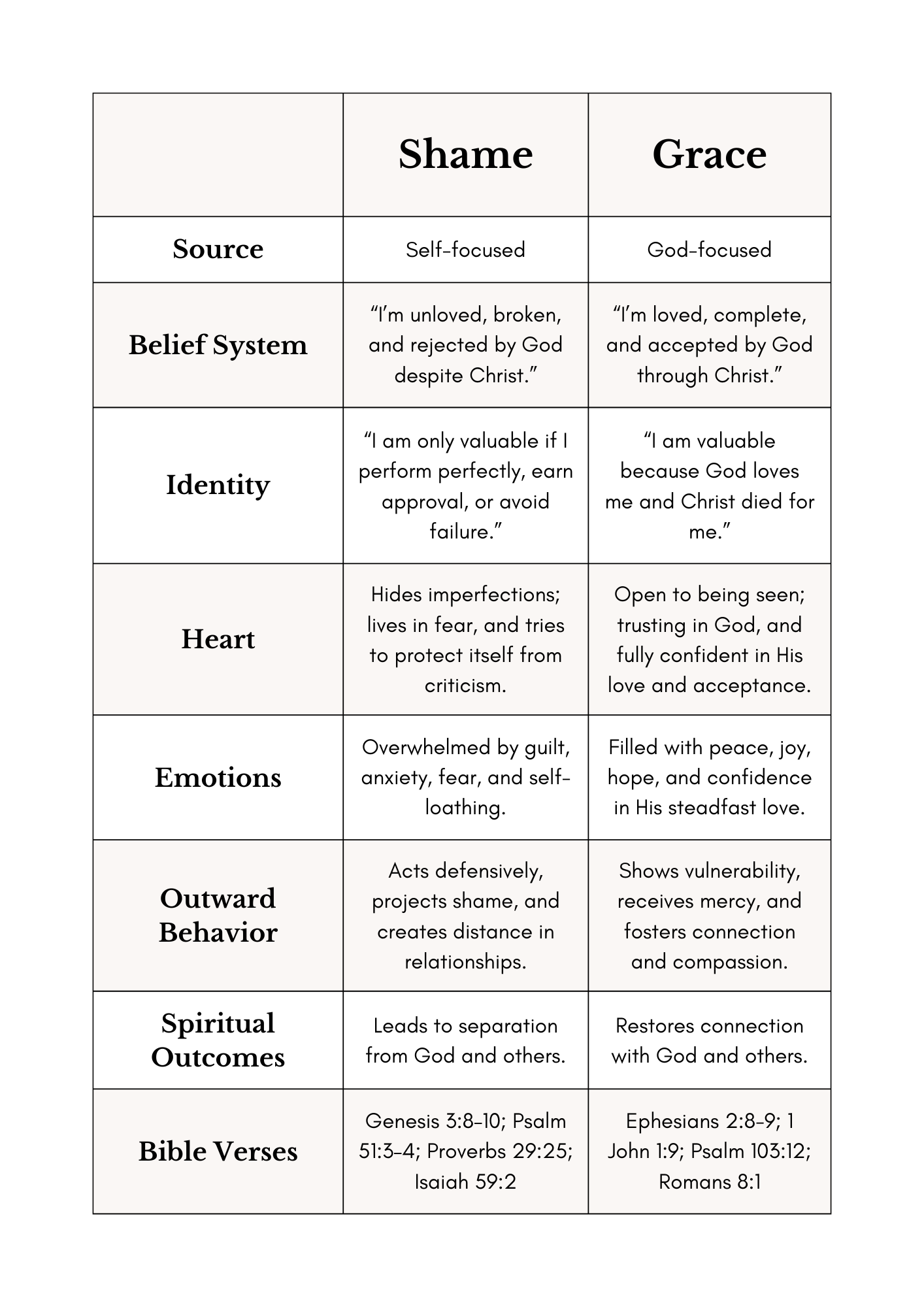
Since I was raised with a perfectionist mindset, I often heap criticism on myself, expecting this to help me grow. But the opposite is true. Over time, I’ve realized that to fully accept God’s grace, I must let go of self-imposed shame. For shame is self-focused, diving into every failure of myself, while grace is God-focused, rooting me in His unrelenting love through Jesus Christ.
- The voice of shame: “You must hide, earn love, and fix yourself first.”
- The voice of grace: “You are loved, accepted, and free regardless of performance.”
Shame thrives in secrecy. It doesn’t want to be seen or loved. It hides in the heart, so we often forget it’s there. That is, until someone points out our shortcomings and our flesh inevitably rears. We try to cover up our shame with pride, which doesn’t heal shame, but only hides it for a time. And inevitably, pride comes at the expense of others, so the very shame we wish to avoid, we heap onto others. In this way, shame begets shame.
Grace, however, lives in the light. It rejoices in being seen and loved despite its imperfections. Why? Because grace is not afraid of judgement. It helps us bring our weaknesses into the open, trusting that we will not be condemned, but met with mercy, love, and wisdom. Shame loses every time a heart is humble enough to give or receive mercy. And according to Scripture, “God desires mercy, not sacrifice.” (Hosea 6:6)
For simplicity sake, here’s a chart showcasing the clear differences between shame and grace:
Speak God’s Grace Over Your Heart
Shame keeps us in suffering, begging for freedom God has already freely given through Jesus Christ. As Christians, we must remind ourselves that we are not defined by our failures, performance, or what others say. We are defined by our identity in Christ. God’s grace has the final word over our lives!
Shame may sound holy, but it’s inherently destructive. Let’s look at a few faith-based examples:
- “I shouldn’t feel this way as a Christian”
- “Because I’m struggling, I must be failing God.”
- “If I do this, God will be happy with me.”
- “Because I did that, God must be angry at me.”
- “I’ve messed up too many times.”
- “I’m not good enough for God to love me.”
- “I’ll never measure up.”
This is not God’s heart for you. Mark my words, these are the beliefs of your accuser, and we want nothing to do with him! Jesus Christ did not come to condemn the world, but to save the world. We must believe in His inherent love, mercy, and grace. Here’s what God’s grace sounds like in response:
- “God sees my feelings and meets me in them.”
- “Struggles don’t disqualify me from God’s love.”
- “God’s pleasure in me is based on who I am in Christ, not in what I do.”
- “Christ’s sacrifice covers my mistakes.”
- “My worth comes from being God’s child.”
- “I don’t have to be enough, God already loves me.”
- “I don’t have to measure up, Christ already did for me.”
When you catch yourself in shame, pause, name the lie, and speak God’s truth over your heart. One helpful practice is to write the lie down, then write Scripture next to it. This will help you replace shame-filled lies with God’s truth about you. Over time, the chains of shame will loosen, and you will embrace the grace God has already given you.

Final Thoughts
I’m still learning what it means to accept God’s grace rather than to strive for His approval. But the more I read the Bible, the more I’m convicted that shame doesn’t get the final say.
As humans, we try to conceal ourselves from God, hoping He won’t see our flaws. But we forget the truth about Him: He is all-knowing, loving, merciful, and kind. His Spirit living in us as believers intercedes for our innermost thoughts, groaning deeper than words. (Romans 8:26)
God isn’t in the business of helping us hide our sins. In fact, He sent His Son to shine light in the darkness of our souls. This process of sanctification can be painful, but it is exactly the healing our souls need: to be fully known, fully seen, and unconditionally loved by God.
Let’s remember to rest in his grace, fully grasping the width, length, height, and depth of His love, according to Ephesians 3:18-19. He died, so we can truly live—free from shame and transformed by His grace.






Comments +