




When I first arrived in Bali, I was taken aback by the island’s bustling atmosphere. Motorcycles weaved through the crowded streets, cars swerved in and out of lanes, and pedestrians lingered on the streets by open-air warungs. Horns honked, engines roared, and everywhere I looked, I noticed carefully placed offerings: inside my taxi, outside shops, on street corners, and nestled in between temples.
From the get-go, the spiritual atmosphere of Bali was tangible. And throughout my trip, I had the unique opportunity to first-hand experience Bali’s culture, religion, and way of life. Since returning home, I’ve reflected on my experience traveling to Bali as a Christian.
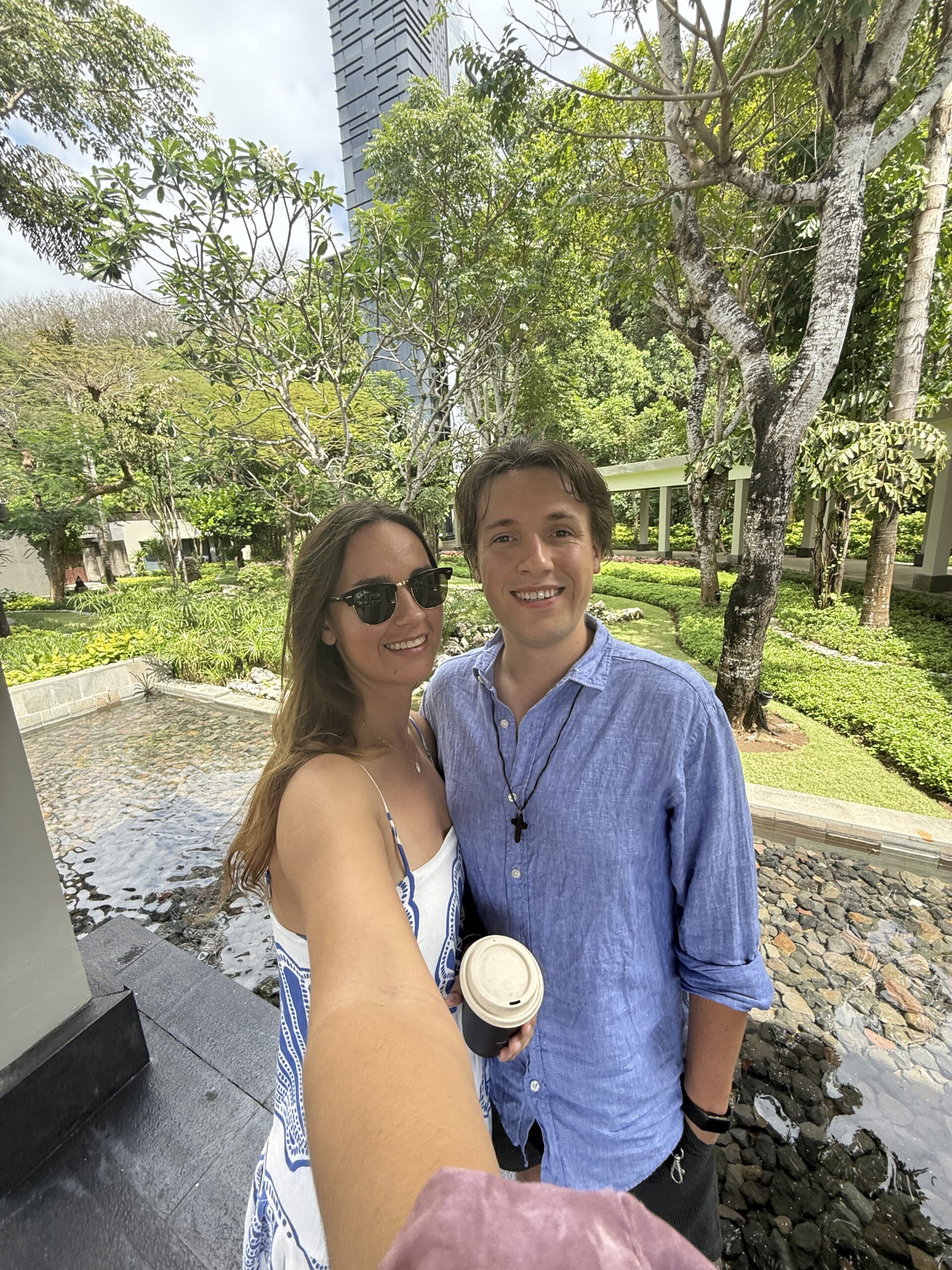
Kim & Jacob here! Nice to meet you 🙂
Traveling to Bali
A God-Ordained Encounter at Taoyuan Airport
God guides my footsteps in fun (and unexpected) ways when I travel. So when I was invited for my friend Christie’s wedding in Bali, I knew I had to seize the opportunity. I invited my boyfriend Jacob as my +1 and we made our travel arrangements.
On our way to Bali, we flew through Taoyuan International Airport for a five-hour layover. While my boyfriend wandered off to grab Taiwanese food, I sat down near a Hello Kitty-themed gate and prayed: God, protect me, lead me, and guide me on this trip.
And to my surprise, God answered me immediately!

How cute is Taoyuan International Airport? Every gate had a theme!
A young woman asked if she could sit next to me. Soon after, I noticed her cross necklace. With a bit of courage, I decided to ask her about her faith, and why she was traveling to Bali.
“I’m working in Bali as a missionary. We’re working on stopping human trafficking,” she informed me.
I was blown away! I then suspected that this encounter was a “divine appointment,” and for the next hour, we talked about her experience as a Christian on Bali.
By the end, I was deeply encouraged. She’d found a solid community in Bali, was brave enough to ride scooters alongside locals to-and-from work, and was encouraged by the church attendance she’d seen from locals. “Every week, locals are coming to church for the first time,” she explained. “The Balinese have many questions, but they are receiving answers, and then giving their lives to Christ.”
When I asked her about any downsides to island life, she was honest: “The air quality is poor, so it can be difficult to breathe. And there’s also a heaviness to the atmosphere, too. Sometimes, I notice I am discouraged to open my Bible, but it’s easy to get complacent when you’re on island time.”
After learning this, I adopted a new motto for my trip: stay close to God and you’ll be good. After exchanging numbers and jotting down the name of her church (20 minutes from my hotel in Bali), we parted ways.
Once I reconnected with my boyfriend, I couldn’t help but chat excitedly about our encounter. God had already connected me with a fellow believer! What else would He do?
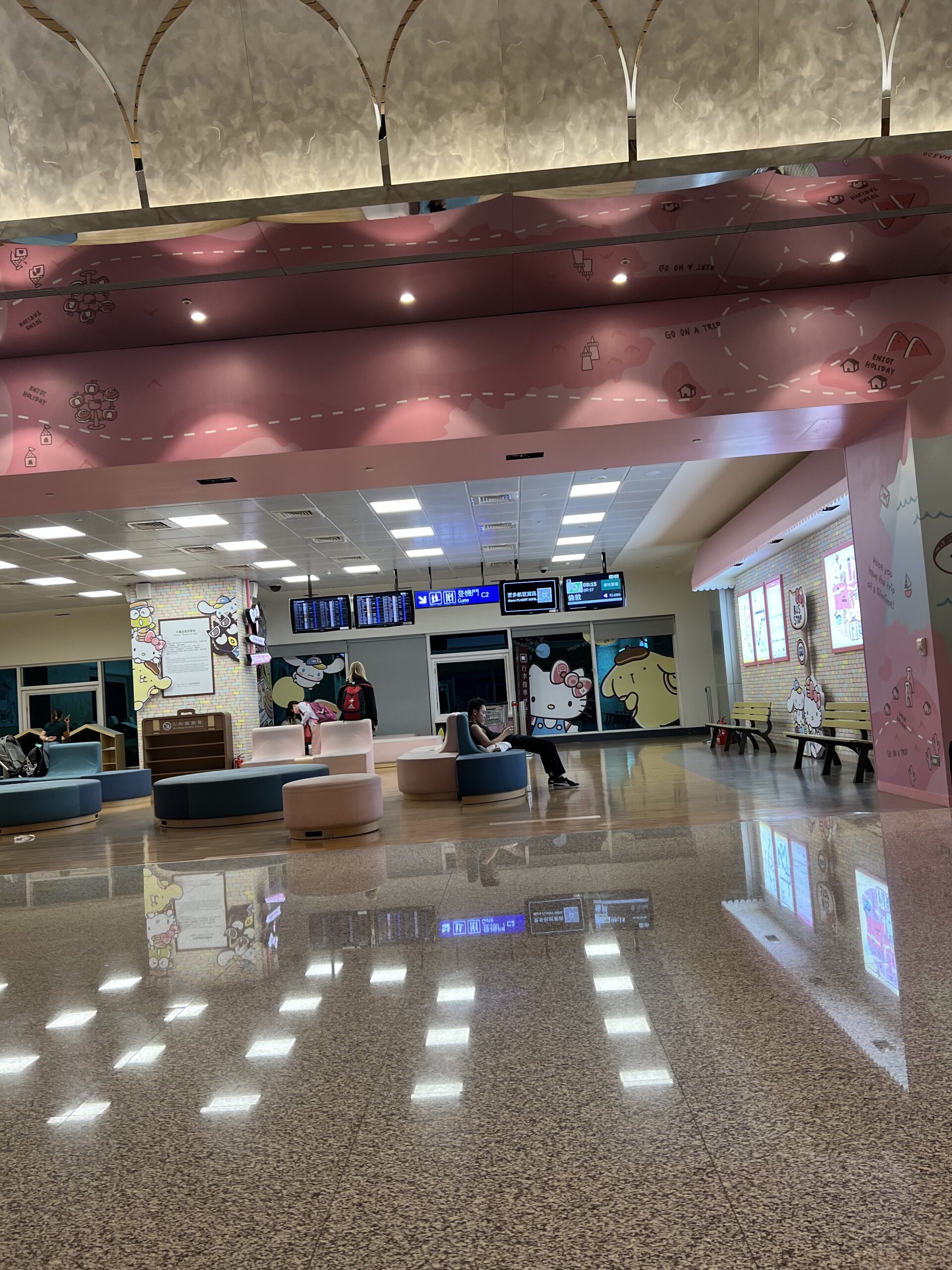
Peep the Hello Kitty Gate!
Exploring Bali
After a whirlwind 30-hour trip, consisting of 3 flights (Denver → Seattle → Taiwan → Bali), Jacob and I arrived jet-lagged but ready to explore. We checked in with a local tour company to see a few local highlights: the Monkey Forest in Ubud, the Tegalalang Rice Terraces, and the Tegenungan Waterfall.
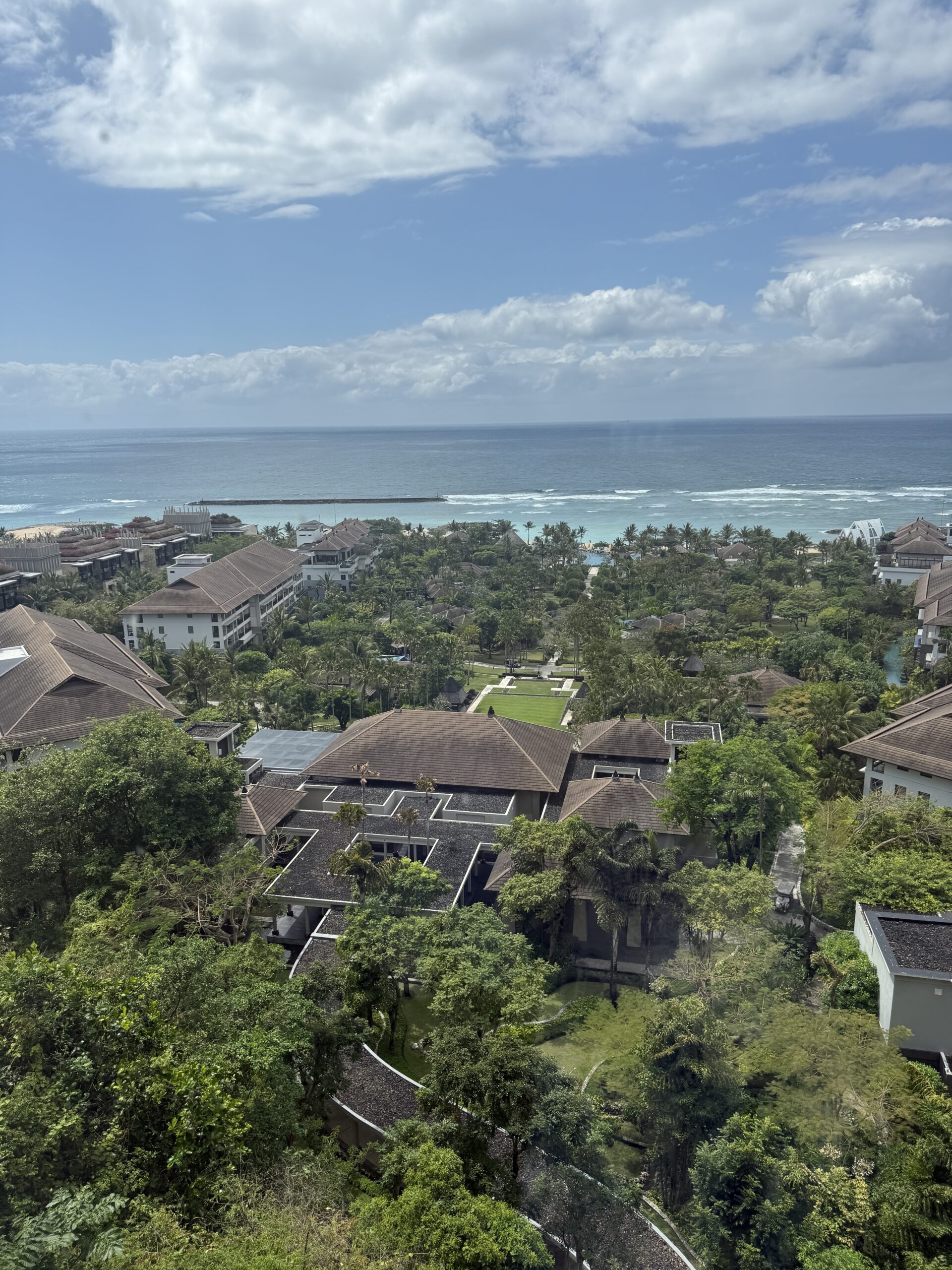
A view of Nusa Dua, where we stayed for our friend’s wedding!
Thankfully, our trip included a local driver and a tour guide, so the next day we began our drive north through the crowded streets of Ngurah Rai International Airport. The city gave way to glimpses of Bali’s beauty. A beautiful tropical landscape, where vibrant flowers, lush forests, flowing rivers, rushing waterfalls, and regal mountains interspersed the landscape. My favorite stop was the Monkey Forest, consisting of 25-acres where you can see Bali’s monkeys up close.
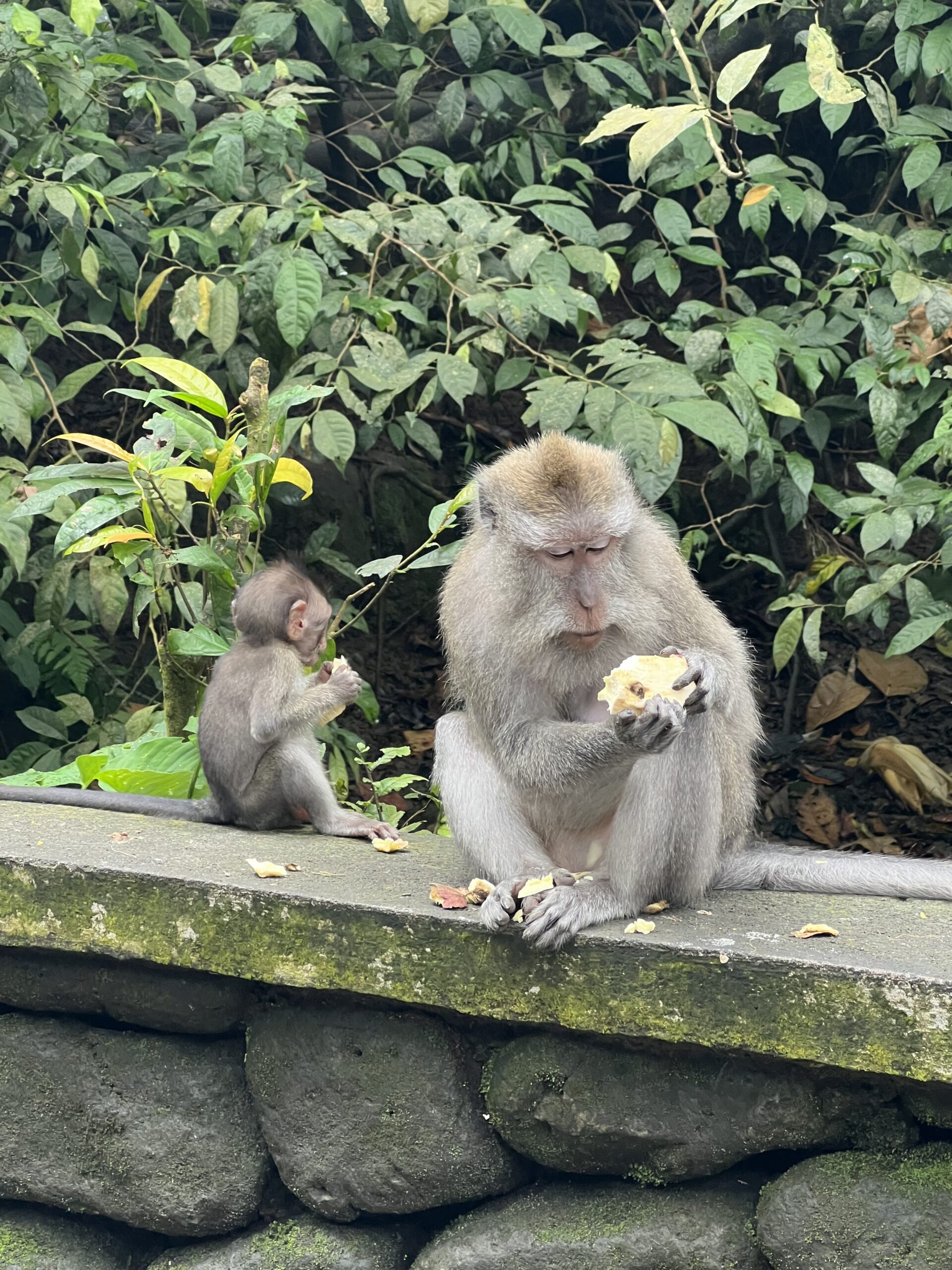
A very cute duo!
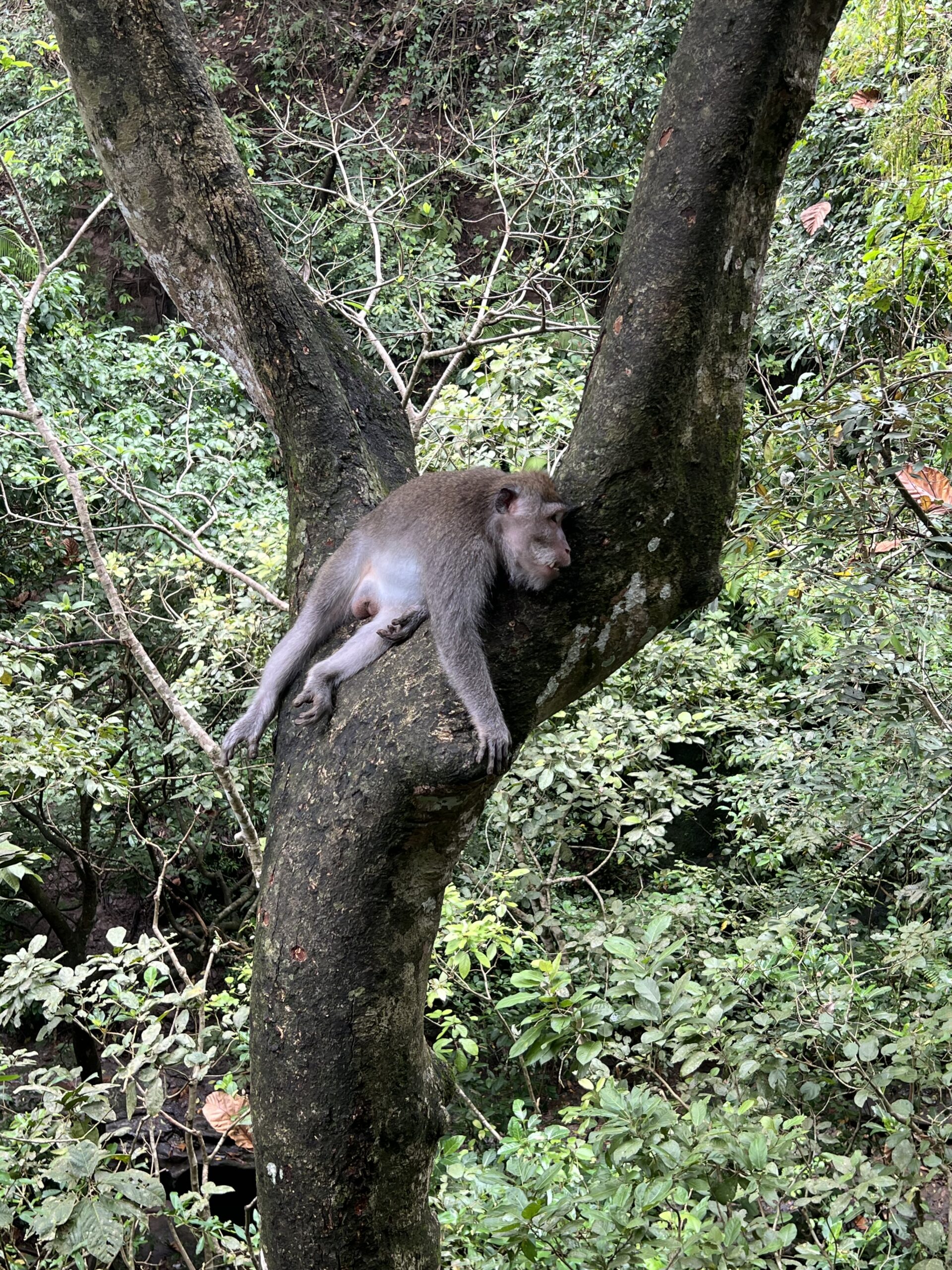
How I felt with my jet-lag…
We also explored rice paddies, which have been cultivated in Bali for over 2,000 years. I enjoyed watching the ducks eat the pests and weeds in the fields. I also loved the local flowers: plumeria, hibiscus, bougainvillea, birds of paradise, marigold, and many other varieties!
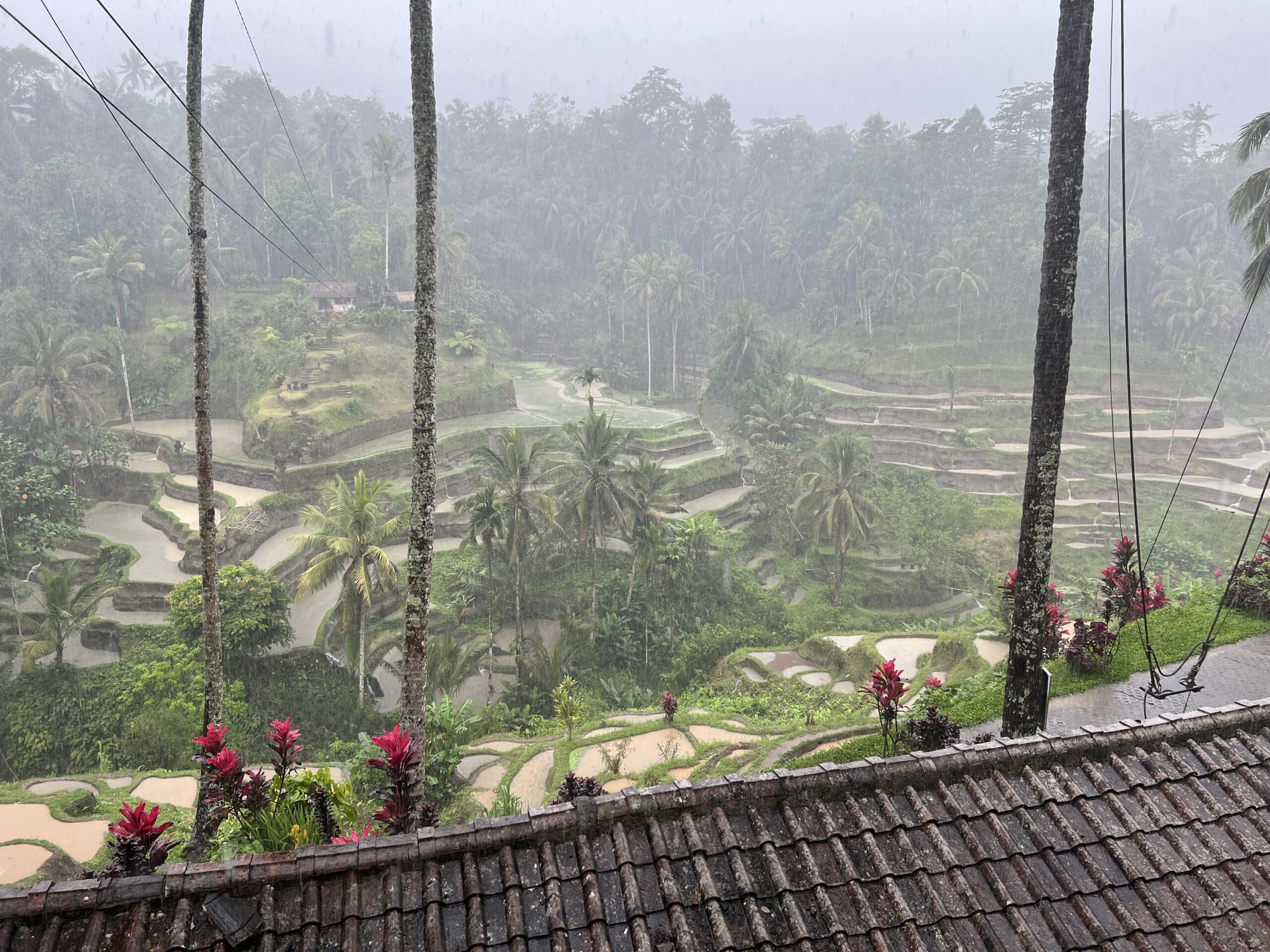
Tegalalang Rice Terraces
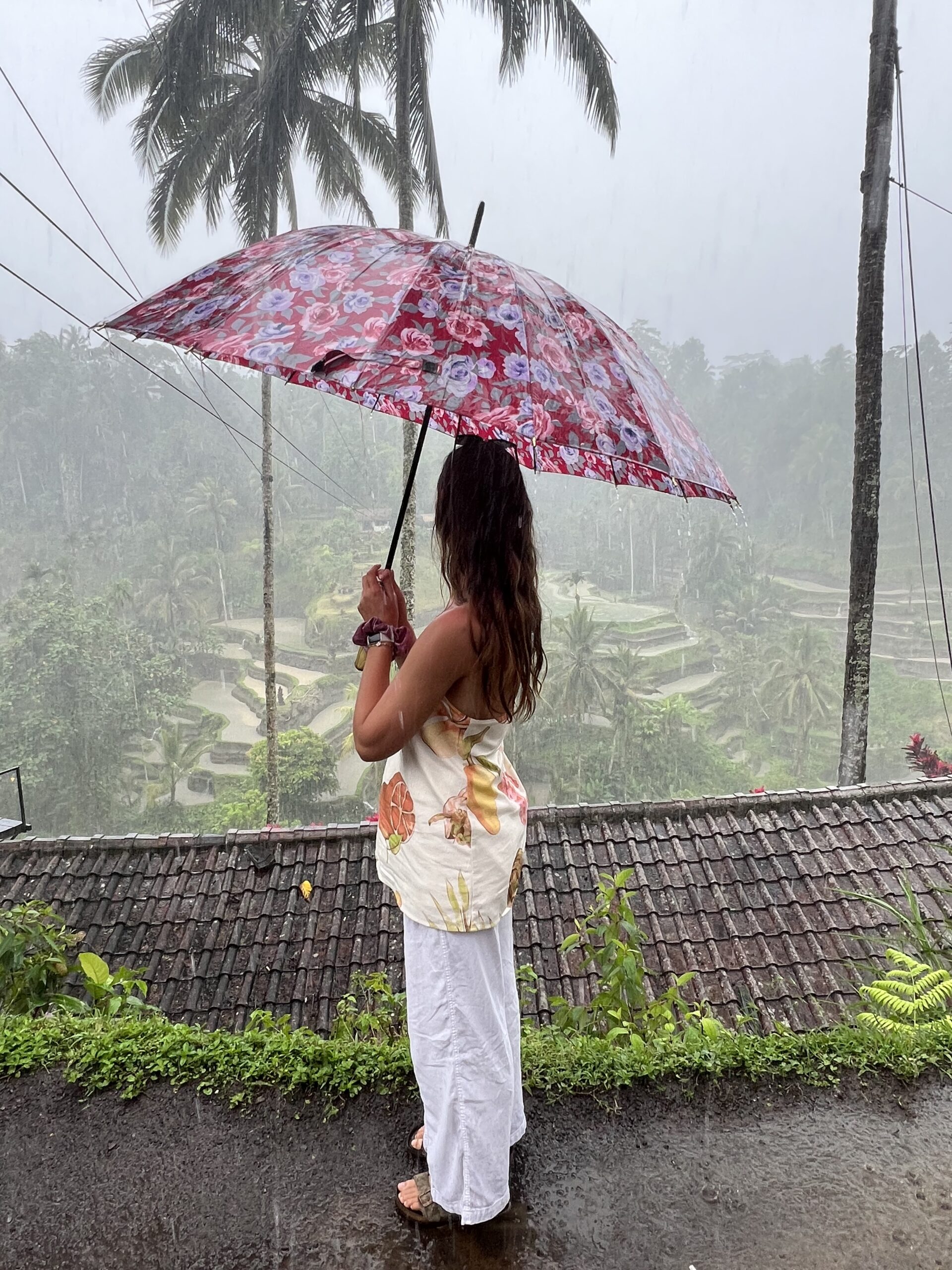
Drenched head to toe!
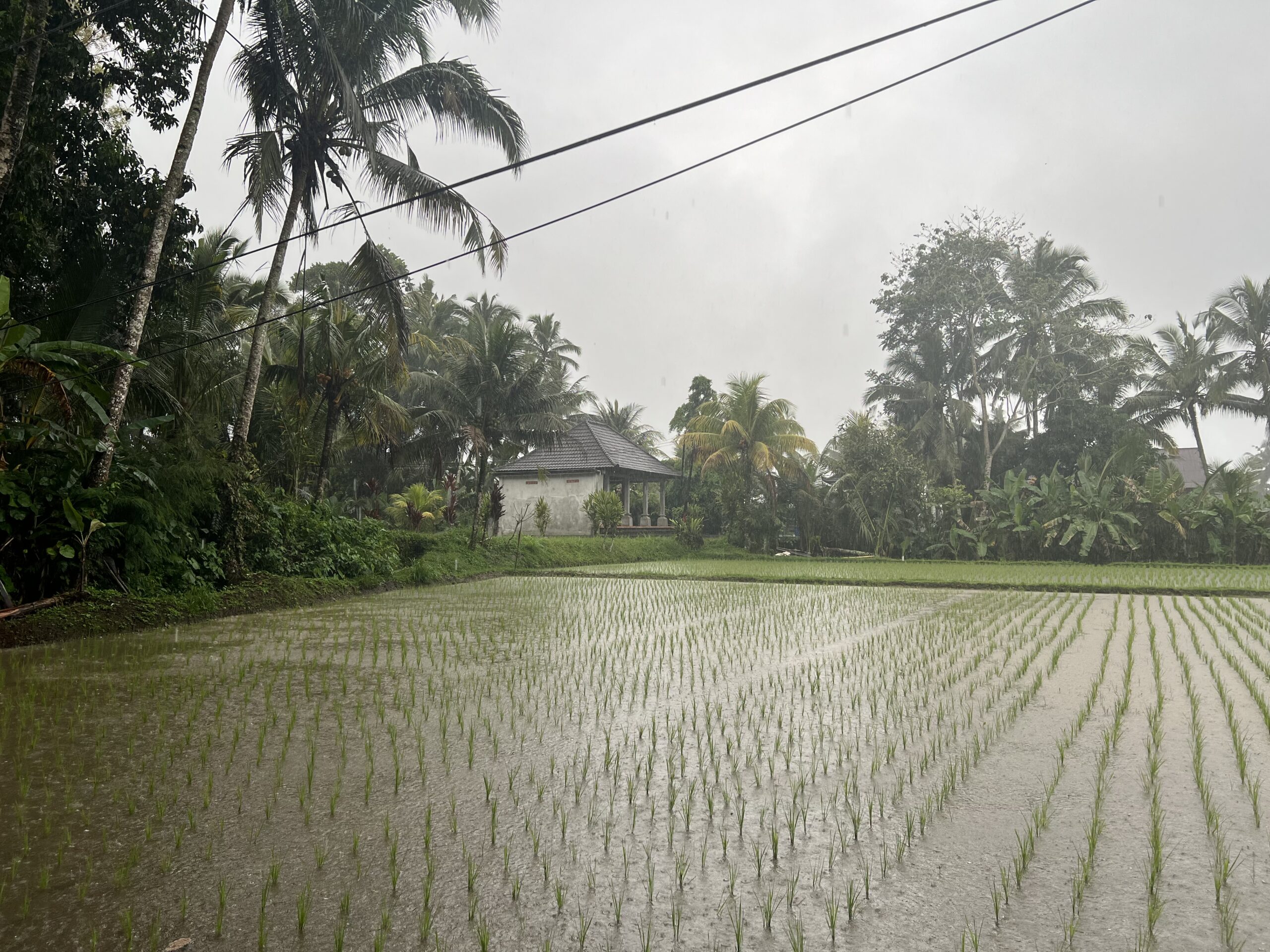
A local rice paddy field.
On our journey, a massive monsoon arrived! Intense amounts of water poured down from the sky, rushed through the streets, and submerged many cars. This experience gave me an appreciation for our driver, who navigated the streets seamlessly.
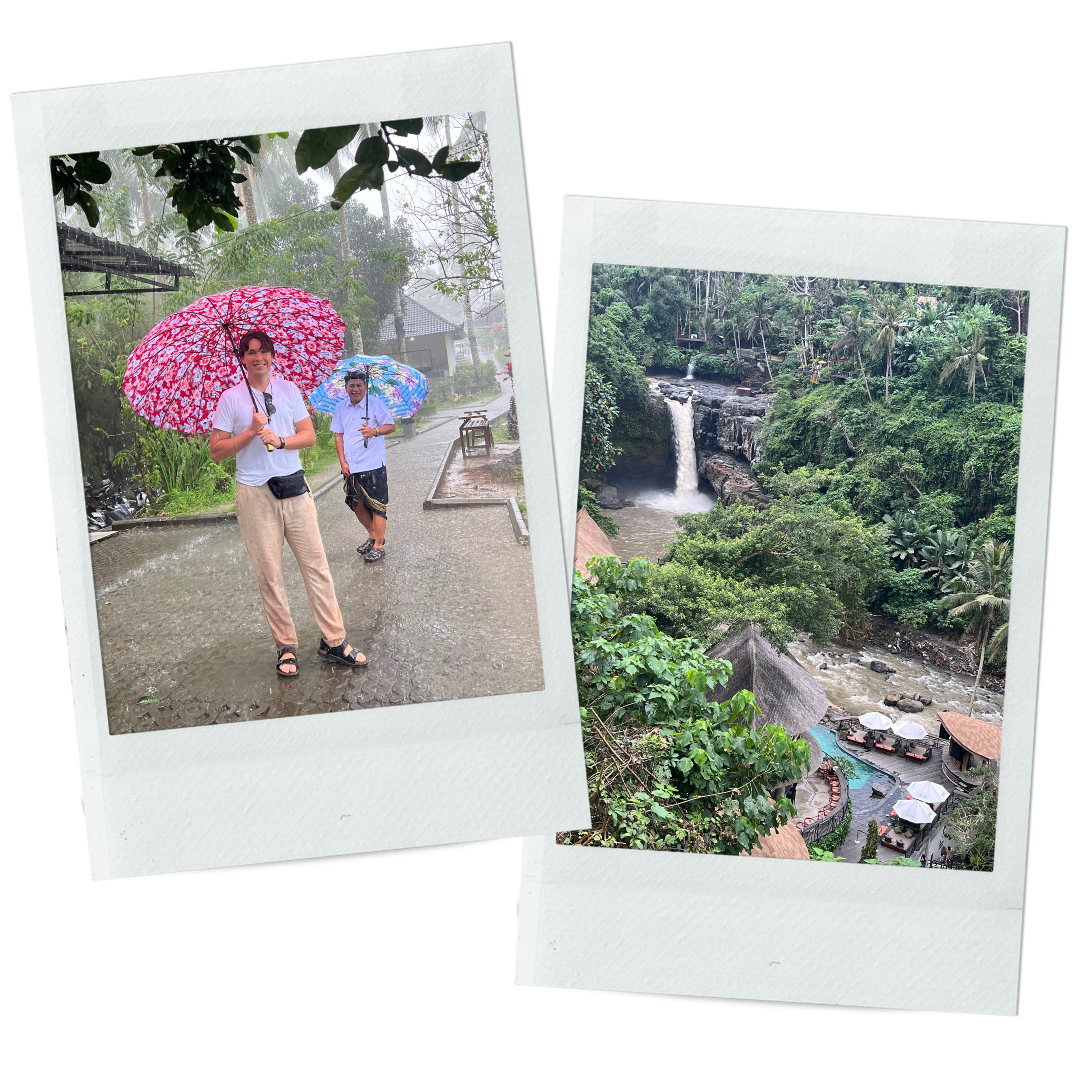
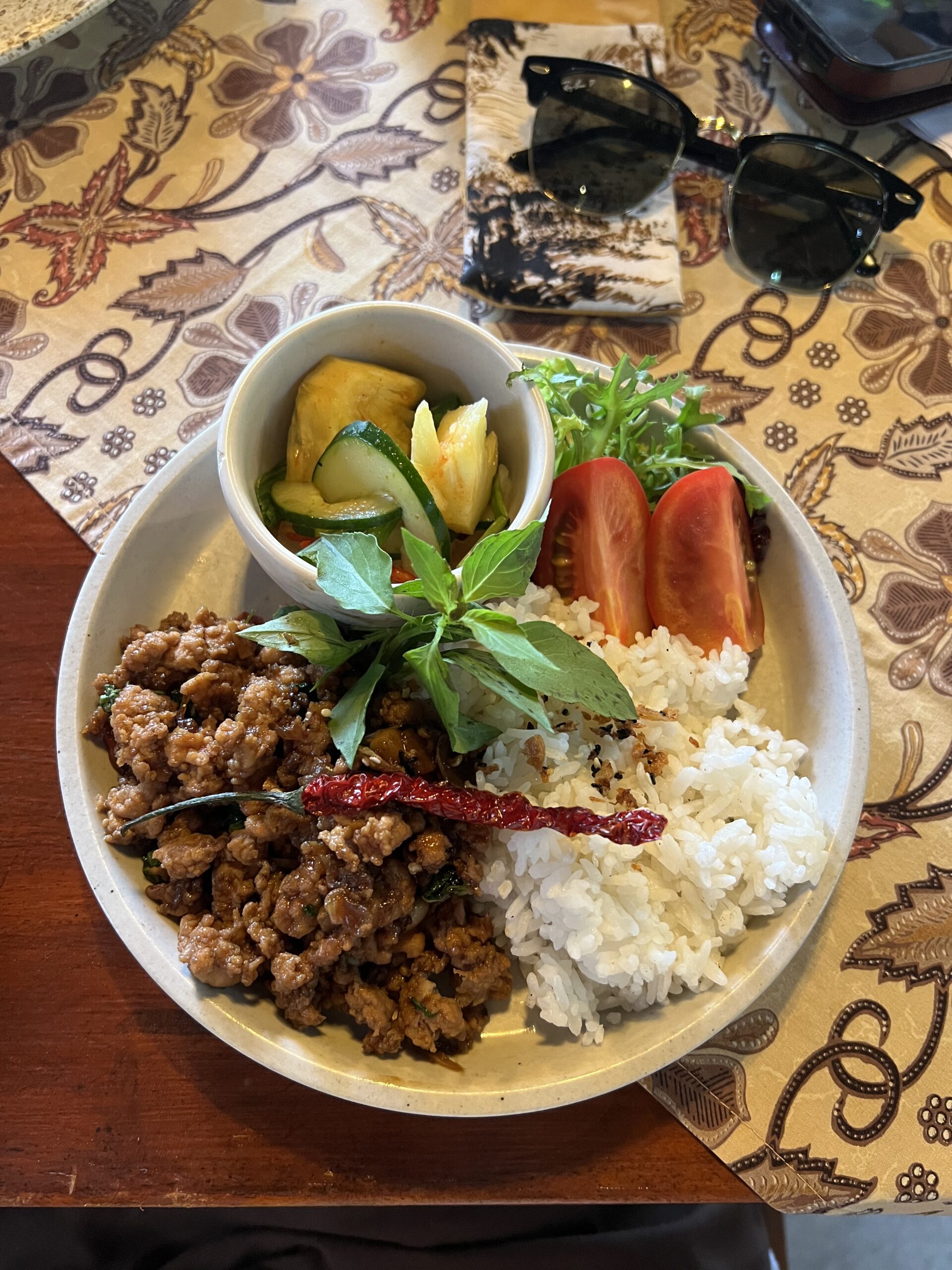
A hot meal on a rainy day. Delicious!
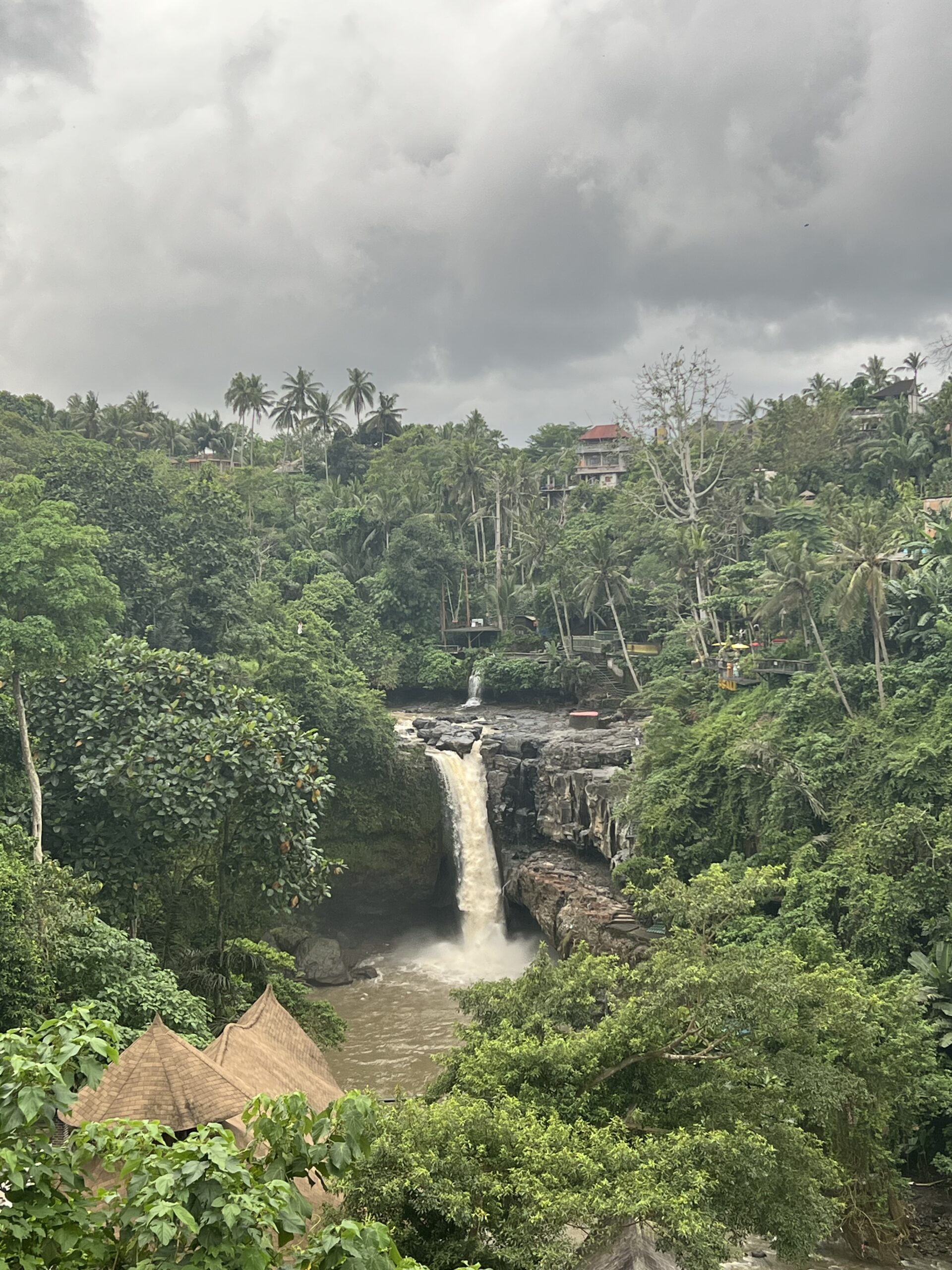
The Tegenungan Waterfall, rushing with fresh rainfall.
Experiencing Balinese Culture
As we drove through Bali, I noticed a variety of handmade offerings, placed by doorsteps, dashboard altars, sidewalks, storefronts, and statues. I also studied the lava rock statues and temples, engraved with figures of Balinese deities. Knowing these practices were connected to Balinese Hinduism, I asked my tour guide, Ketut, many questions about his culture and religion. I’ve documented his answers below.
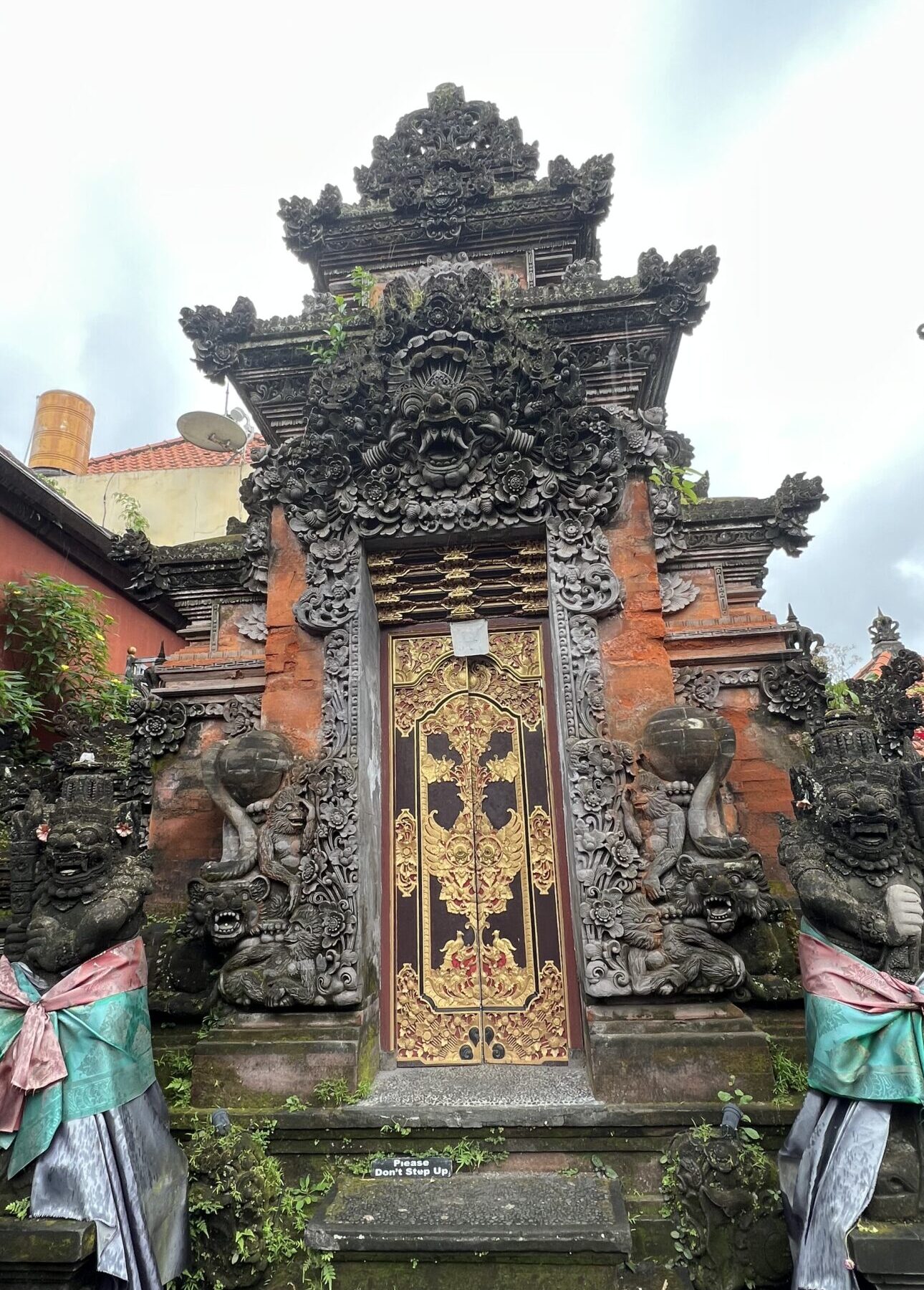
An example of Balinese carvings in the Ubud Royal Palace.
A Pillar of Balinese Culture: The Caste System
When my tour guide informed me about the Balinese caste system, known as the catur wangsa, my mind was filled with questions.
Ketut explained the basics of the four-tiered caste system, where 93% of Balinese people belong to the lowest caste. Unlike the Indian caste system, Bali’s version doesn’t include an “untouchable” caste. But Balinese social status is determined by birth:
- Brahmana – priests
- Satriya – warriors/nobility
- West – merchants and administrators
- Sudra – commoners (the majority)
Ketut also explained how the caste system shapes cultural customs, which include:
- People of different castes do not share meals.
- You’re not allowed to touch the head of someone from a higher caste.
- Marrying within your caste is strongly encouraged.
He also walked us through the naming system. In Bali, names reveal not only your birth order but also gender and caste. For those in the Sudra caste (the majority), children are typically named in this order:
- Wayan (first)
- Made (second)
- Nyoman (third)
- Ketut (fourth)
After the fourth, the pattern repeats. Our guide’s name was Ketut, and our driver’s name was Wayan. Ketut laughed and said: “If you call out a name in public, be prepared for everyone to raise their hand!”
He wasn’t kidding! Our taxi driver back at the airport had also been named Wayan. Needless to say, we felt a bit of culture shock!
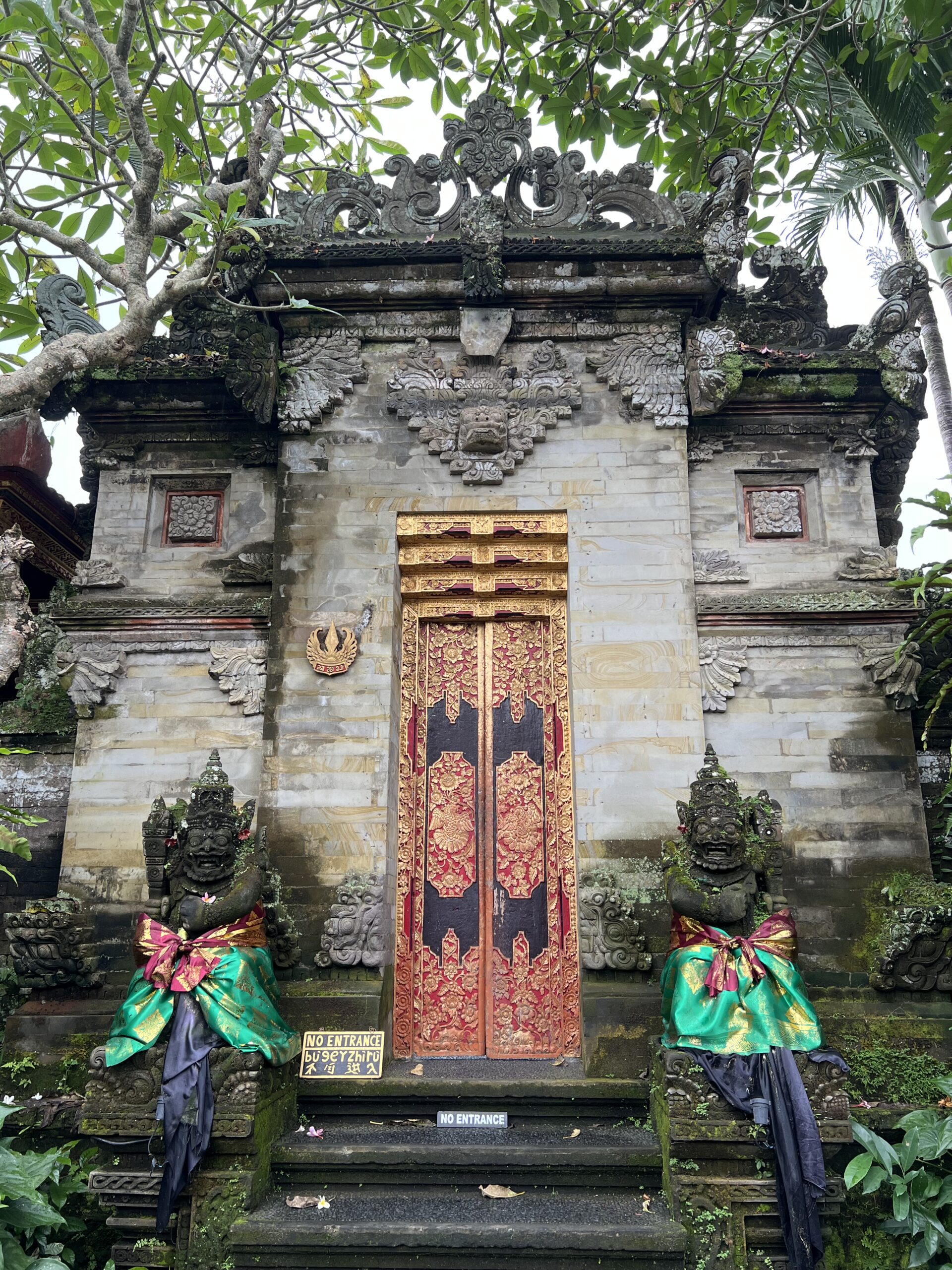
The Ubud Royal Palace.
The Majority Religion: Balinese Hinduism
Ketut also explained the basics of Balinese Hinduism, which is the dominant religion on the island of Bali (practiced by 87% of the population). To put it simply, Balinese Hinduism is a blend of Hindu beliefs, indigenous animism, and Buddhist principles.
Since the Indonesian government requires all recognized religions to believe in one, single God, Balinese Hindus acknowledge one supreme God, known as Sang Hyang Widhi Wasa. Nevertheless, Balinese Hindus also worship many other deities, including the Hindu trinity (Brahma, Vishnu, and Shiva), along with hundreds of lesser gods, goddesses, and local spiritual beings.
Every day, millions of small offerings (canang sari) are prepared for local spirits.
When I asked Ketut about the purpose of the offerings, he said:
- “We believe in good and evil spirits. We make offerings to the spirits to try to maintain the equilibrium between good and evil.”
This concept of balance came up again when I noticed black-and-white checkered cloths wrapped around trees and statues across the island. Ketut told me:
- “They are crafted to represent the balance between light and dark.”
Later, I noticed white cross marks painted on buildings, doorways, and storefronts, so I asked Ketut to explain.
- “In Bali, we believe in white and black magic. People draw the white marks to guard their homes against evil spirits.”
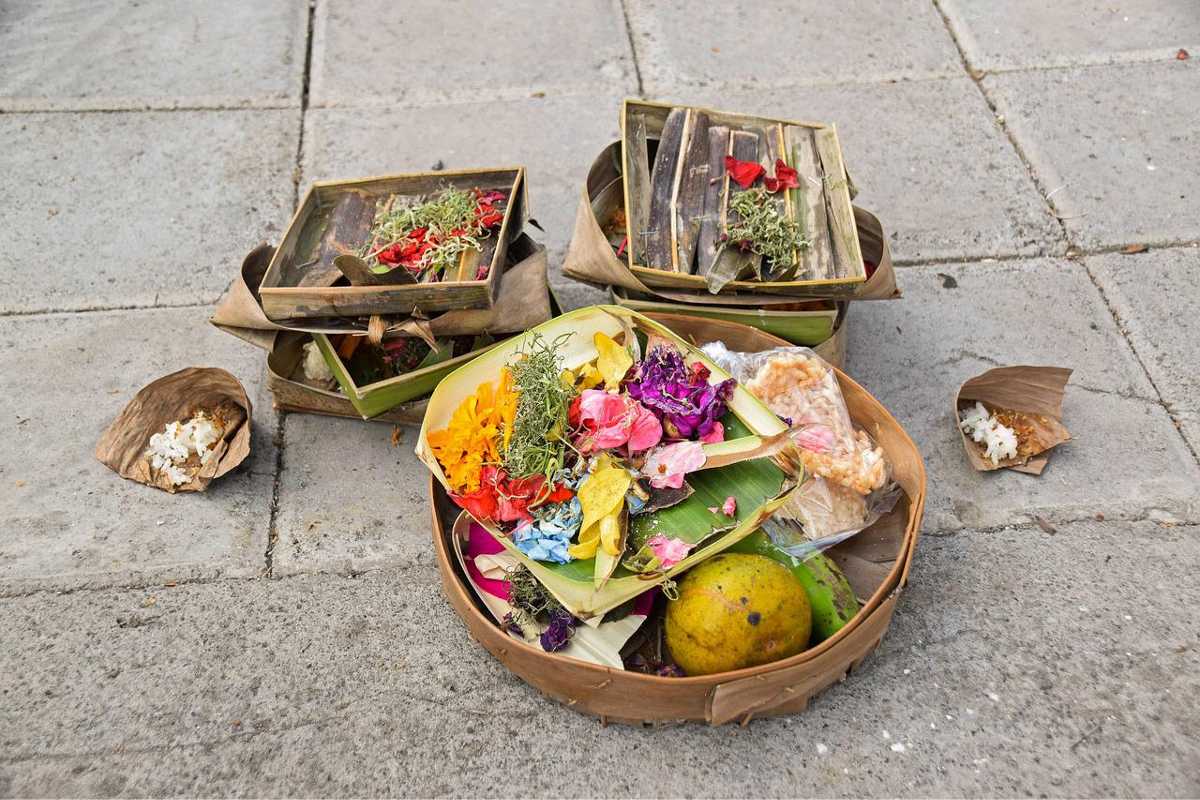
Canang sari offerings (via Bali.com)
Balinese Spirituality
After taking with Ketut, I began to grasp the spiritual reality of Bali, an island where most people actively engage with the spiritual world in the physical world. Ketut spoke openly about the role of witchcraft, explaining the role of “black” witchcraft (with the intent to harm) and “white” witchcraft (with the intent to prevent harm).
Since Balinese life is deeply centered around coexistence with spirits, nearly every Balinese Hindu tradition or ritual is designed to invite, appease, or protect against spirits. The ultimate intention is to bring balance between the seen and unseen worlds. A few examples of Balinese spirituality include:
- Daily offerings to invite benevolent spirits and appease malevolent spirits.
- Shrines or statues for spirits to inhabit once properly blessed.
- House blessing ceremonies to invite spirits to inhabit and protect the space.
- Temple ceremonies like Galungan, which mark the time when ancestral spirits are believed to visit their earthly families, or Kuningan, which marks their return to the spiritual realm.
- Trance ceremonies like Sanghyang Dedari to invite spirits to temporarily dwell in or with a person.
Likewise, the Balinese are well aware of spiritual danger. This is why the Balinese calendar includes specific holidays designed to ward off evil spirits. One of the most notable holidays is the Ogoh-Ogoh parade, held during Ngrupuk, the day before Nyepi (Balinese New Year). On this night, massive effigies of demons are paraded through the streets, then burned to symbolically destroy the negative spirits.
All to say: Balinese Hindus are no stranger to the spiritual world!
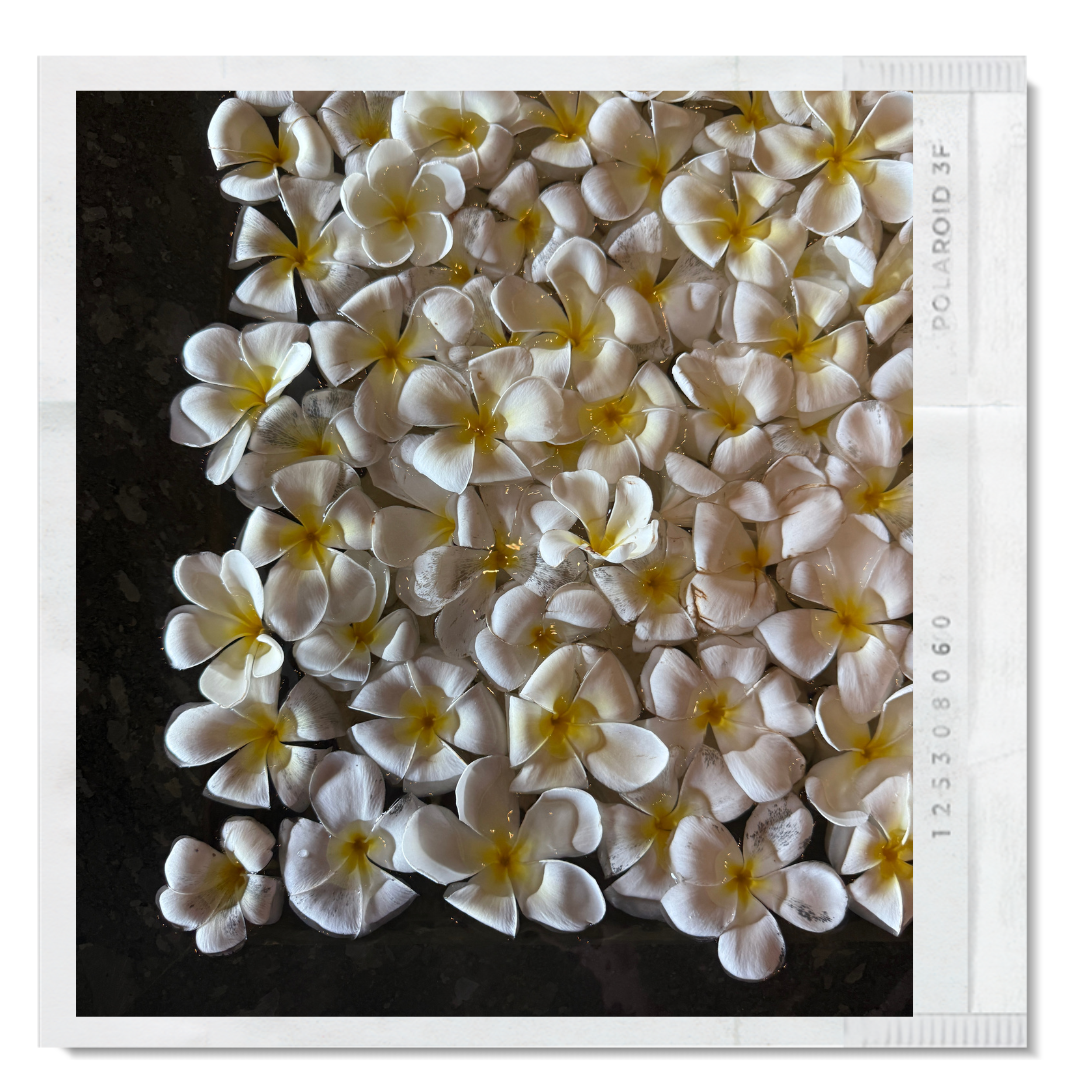
“Frangipani flowers,” which are revered in Balinese culture.
My Spiritual Perspective as a Christian
As a Christian, I carry my own unique perspective on spiritual truth. Below, I’ve taken time to respectfully compare my beliefs with Balinese Hindus. I wish to share these beliefs with love, as I believe we all are made in the image of God.
Hello, it’s us again! 🙂
Reflecting on the Balinese Caste System
In Balinese Hinduism, the caste system reinforces a spiritual and social hierarchy, where people are born higher or others lower from birth. This hierarchy is regarded as a cosmic, divine order, and is intended to bring about cosmic balance.
To be honest, I had a difficult time reconciling this system as a Christian. In part because I believe that every human being is made in the image of God (Genesis 1:27) and possesses equal value, dignity, and spiritual worth. Therefore, we cannot be ranked by birth, background, or bloodline.
For reference, here’s a brief comparison between Balinese Hinduism and Christianity when it comes to spiritual status and structure on earth.
Balinese Hinduism
- Spiritual and ritual roles are connected to birth.
- Certain priestly positions are hereditary.
- Everyone can pray and make offerings.
- Spiritual growth happens over many lifetimes through karma.
- Each person has different duties based on their social role (dharma).
- All beings are part of the same cycle of rebirth (samsara).
- Liberation is possible, but usually gradual rather than immediate.
Christianity
- No one is spiritually higher or lower by birth.
- No one has special access to God because of lineage.
- All people equally need grace.
- Salvation is equally available to anyone who believes in Jesus Christ.
- Spiritual identity is not determined by social status.
- Eternal life is received through faith in Jesus Christ, not accumulated over lifetimes.
As a follower of Jesus Christ, I believe that God affirms our individuality! Each person is uniquely created and deeply valued by Him. We are not ranked, but regarded as His children. So in God’s Kingdom, there’s only one entry requirement: faith in Jesus Christ. “Everyone who calls on the name of the Lord will be saved” (Romans 10:13).
As a Christian, I also believe that all dividing lines among humans are erased: “There is neither Jew nor Gentile, slave nor free, male nor female, for you are all one in Christ Jesus” (Galatians 3:28). Therefore, we cannot be segregated. All followers of Christ have access to the same spiritual blessings, which include: adoption as God’s children, redemption, forgiveness of sins, receiving the Holy Spirit, and everlasting life in God’s presence.
Comparing Balinese Hinduism with Christianity
Balinese Hindus believe in one supreme God, but also worship a wide array of deities, demons, ancestral spirits, and divine beings, including the Hindu trinity (Brahma, Vishnu, Shiva). The typical Balinese family compound puts forward a minimum of 15 offerings each day for spirits, which they believe will help humans maintain balance with the spirit world.
Balinese Hindus also believe in reincarnation, or the concept of an endless cycle of birth, death, and rebirth, whereby your actions in this life affect future rebirths. The ultimate goal of Balinese Hindus is to achieve liberation (moksha) from the cycle, whereby you are one with God. That is why Balinese Hindus worship spirits for they believe they directly influence one’s journey through reincarnation to liberation.
In contrast, Christians believe in one God, existing as three co-equal, co-eternal, and distinct persons: the Father, the Son (Jesus Christ), and the Holy Spirit. We also believe in a spiritual world for God created angels as holy messengers and instruments of His will. Unfortunately, one-third of all heavenly angels rebelled against God and fell from heaven to earth. According to the Bible, Satan and his fallen angels (demons) now seek to kill, steal, and destroy all things made in God’s image on earth.
That’s why Christians believe that any interaction with earthly spirits (demons) opens us up to spiritual harm. Since demons long for us to worship them in lieu of God, God is clear on His stance: “You shall have no other gods before me.” (Exodus 20:3). To unpack the Christian view of demons or false gods, please consider these Bible verses:
- “They made him jealous with their foreign gods and angered him with their detestable idols. They sacrificed to demons, not to God, to gods they had not known, to new gods that had come recently, whom your fathers did not fear.” (Deuteronomy 32:16–17)
- “They exchanged the truth about God for a lie, and worshiped and served created things rather than the Creator—who is forever praised. Amen.” (Romans 1:25)
- “No, but the sacrifices of pagans are offered to demons, not to God, and I do not want you to be participants with demons. You cannot drink the cup of the Lord and the cup of demons too; you cannot have a part in both the Lord’s table and the table of demons.” (1 Corinthians 10:20–21)
A Personal Warning Against Engaging in Witchcraft
Both Balinese Hindus and Christians believe in the existence of a spiritual world. Nevertheless, the difference in our spiritual beliefs grows stark when it comes to how we engage with these spiritual forces on earth.
Since Balinese Hindus believe in good and evil spirits, Balinese witchcraft is conducted to invite good spirits or ward off evil spirits. In contrast, Christians believe that all spirits on earth are demons (evil spirits) masquerading as angels of light. Therefore, we are forbidden to practice witchcraft by God because there is no safe way to engage with demons.
As a Christian, I have it on my heart to warn those dabbling in witchcraft to turn away and call out to Jesus Christ for protection. I simply do not want any human to be harmed, led astray, or oppressed by demons. Before I became a Christian in my early 20s, I dabbled in all sorts of New Age witchcraft, thinking these spiritual practices would protect me, enlighten me, or lead me to God. They only invited darkness into my life. This is why the Bible warns us:
- “Let no one be found among you who sacrifices their son or daughter in the fire, who practices divination or sorcery, interprets omens, engages in witchcraft, or casts spells, or who is a medium or spiritist or who consults the dead. Anyone who does these things is detestable to the Lord.” (Deuteronomy 18:9–12)
As humans, we expect evil to appear in dark or frightening forms. But demons are deceitful! As a Christian, I know that “Satan himself masquerades as an angel of light” and that he is the “father of lies” (2 Corinthians 11:14; John 8:44). That is why I hold fast to this verse: “Our struggle is not against flesh and blood, but against the rulers, against the authorities, against the powers of this dark world and against the spiritual forces of evil in the heavenly realms.” (Ephesians 6:12)
If you are being held captive by the dark forces of this world, please call out to Jesus. He is given authority to forgive us of our sins and free us from all spiritual bondage. Jesus Christ said: “I am the light of the world. Whoever follows me will never walk in darkness, but will have the light of life.” (John 8:12)
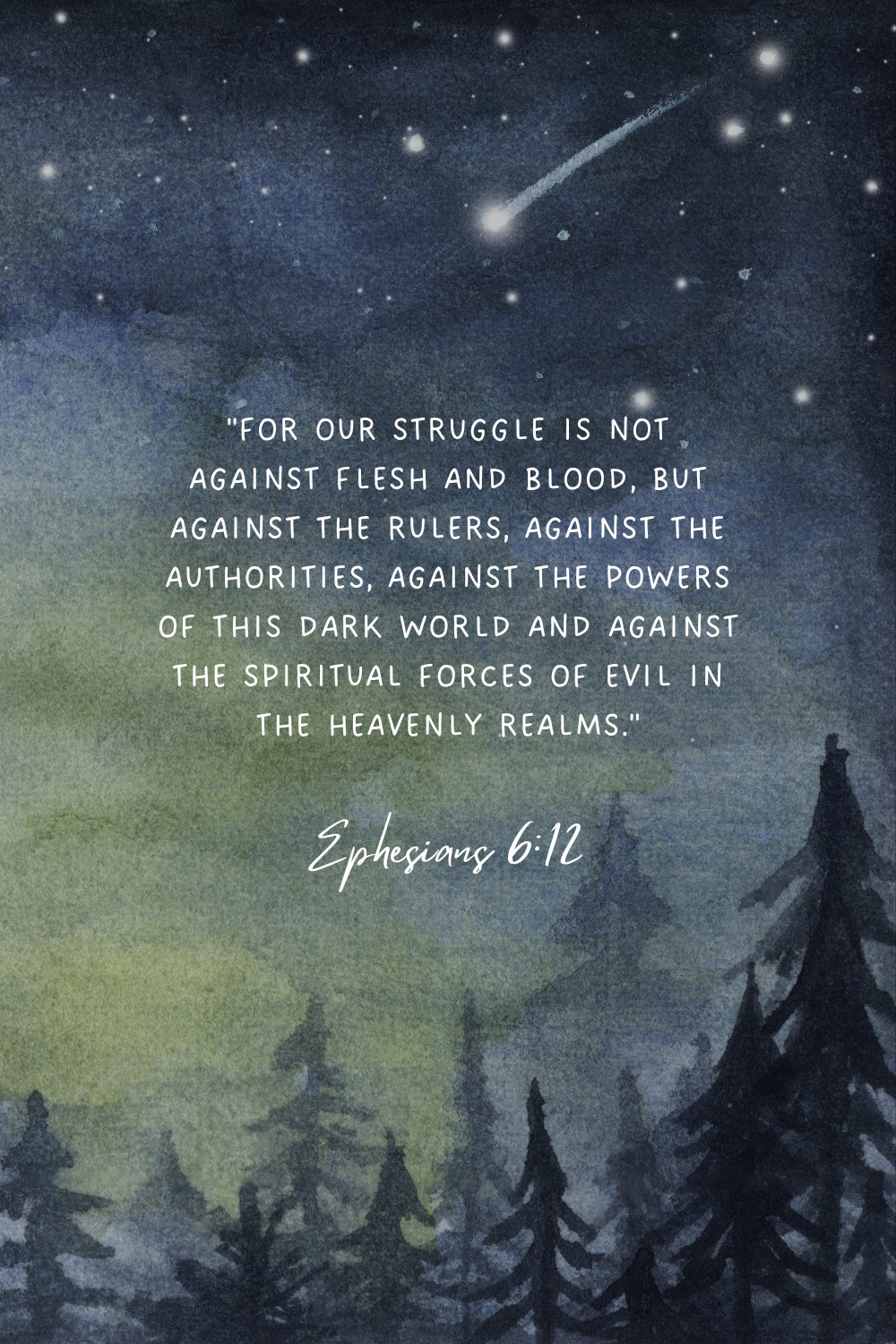
Ephesians 6:12 is one of my favorite Bible verses!
Saying Goodbye to Bali: An Encounter with a Balinese Christian
Before Jacob and I left Bali, God gave us both a surprise!
We sat down to order lunch at our hotel, and then settled down on a few lounge chairs down by the beach. Shortly after, a young Balinese man named Agung arrived with our order in tow. Mistakenly, we weren’t given silverware, so Agung ran back to the bar to grab a few sets for us. In the meantime, we bowed our heads and prayed: Lord, thank you for this food, for this day, and for all the people around us. Protect us, protect them, and bless this food. In Jesus’ name we pray. Amen.
When I opened my eyes, Agung had already returned. He was quietly watching us. Then he stepped closer and said, shyly: “I pray, too. Before every meal, I pray to Jesus. I’m a Christian.”

A selfie we took right before we met Agung!
Pray for him, the Holy Spirit nudged me. Before I could overthink this, I asked Agung if we could pray. Startled, Agung replied, “Now?” And we did! The three of us held hands and bowed our heads. My boyfriend prayed:
Lord, please be with Agung. We thank him for his service. In all of the ways Agung has given others, may he receive. God, we pray You honor Agung, as he has chosen to honor You in a place where few know Your name. Thank you for his courage to confess his faith. May Agung know that You are proud of him. Please bless him, prosper him, and remind him of how deeply he is loved by You. We know You will be steadfast in his life. In Jesus’ name, we pray. Amen.
When we looked up, Agung was crying. I teared up, too. The presence of God was tangible. That moment I knew God had orchestrated another divine appointment!
Agung placed his hands over his heart and said: “Thank you.” I felt the same immense gratitude in my heart. Thank you, God. Thank you for this wonderful fellowship with a fellow believer.
My Final Thoughts
I’m so thankful for the opportunity to visit the beautiful island of Bali, learn about the Balinese culture, and connect with fellow believers (both at the airport in Taiwan and on a beach in Nusa Dua).
As I reflect on my trip, I send my love to the Balinese people, and see the image of God reflected in their devotion, their love and commitment to each other, and their desire for harmony on earth. Simultaneously, I have an even stronger conviction of the dangers of engaging with spiritual forces (demons) who are in rebellion against God.
If you visit Bali as a Christian, ask God to use you for His will and remember to:
- Stay rooted in the Word.
- Pray continually for yourself and others.
- Ask the Holy Spirit for discernment.
- Walk in the love and authority of Christ.
- Love others as God has loved you.
“Greater is He who is in you than he who is in the world” (1 John 4:4). Wherever you travel, Jesus Christ’s presence is your peace. His outstretched hand extends to all, including the beautiful people of Bali.





Comments +